

Building AI agents in Salesforce Agentforce is not about choosing between low-code and pro-code.
It’s about knowing when to move fast and when to go deep.
Most teams don’t get stuck because of technology. They get stuck because they either over-simplify too long or over-engineer too early.
This guide will help you avoid both.
What is Low-Code in AgentForce
Low-code in AgentForce is your fastest path from idea to execution.
It allows you to build agents using visual tools instead of writing heavy code. You define behavior through configuration, flows, and guided logic.
Key Low-Code Components
- Agent Builder interface
- Flow Builder automation
- Prebuilt actions and connectors
- Prompt and response configuration
These tools allow teams to create functional agents quickly without deep engineering effort.
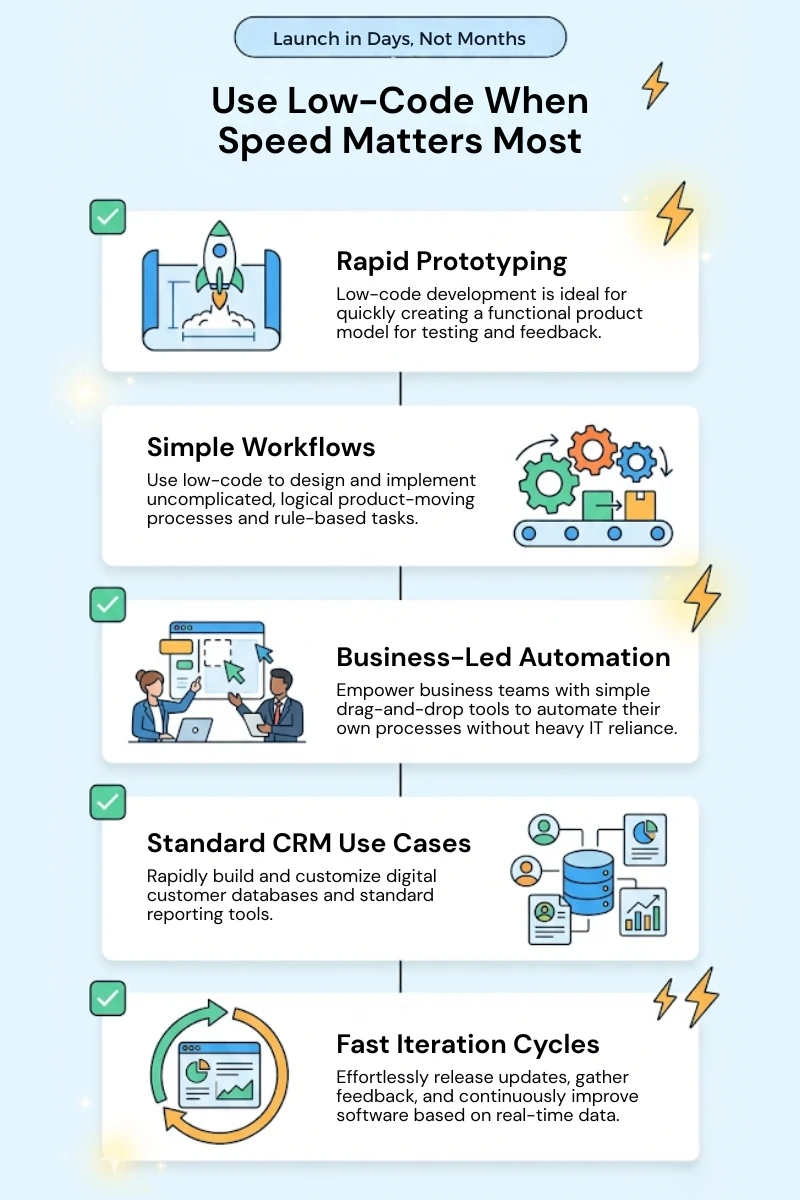
Where Low-Code Works Best
Low-code performs best when speed and flexibility matter more than complexity.
Rapid Prototyping
You can launch a working agent in days instead of weeks. This is ideal when testing new ideas or validating business use cases.
Business-Led Development
Non-developers can actively contribute. Product owners and operations teams can shape workflows without waiting on engineering.
Standard Use Cases
Low-code is highly effective for:
- Customer support automation
- Lead routing and qualification
- FAQ handling
- Internal workflow automation
Faster Iteration Cycles
Changes can be made instantly. No deployment cycles. No heavy testing delays.
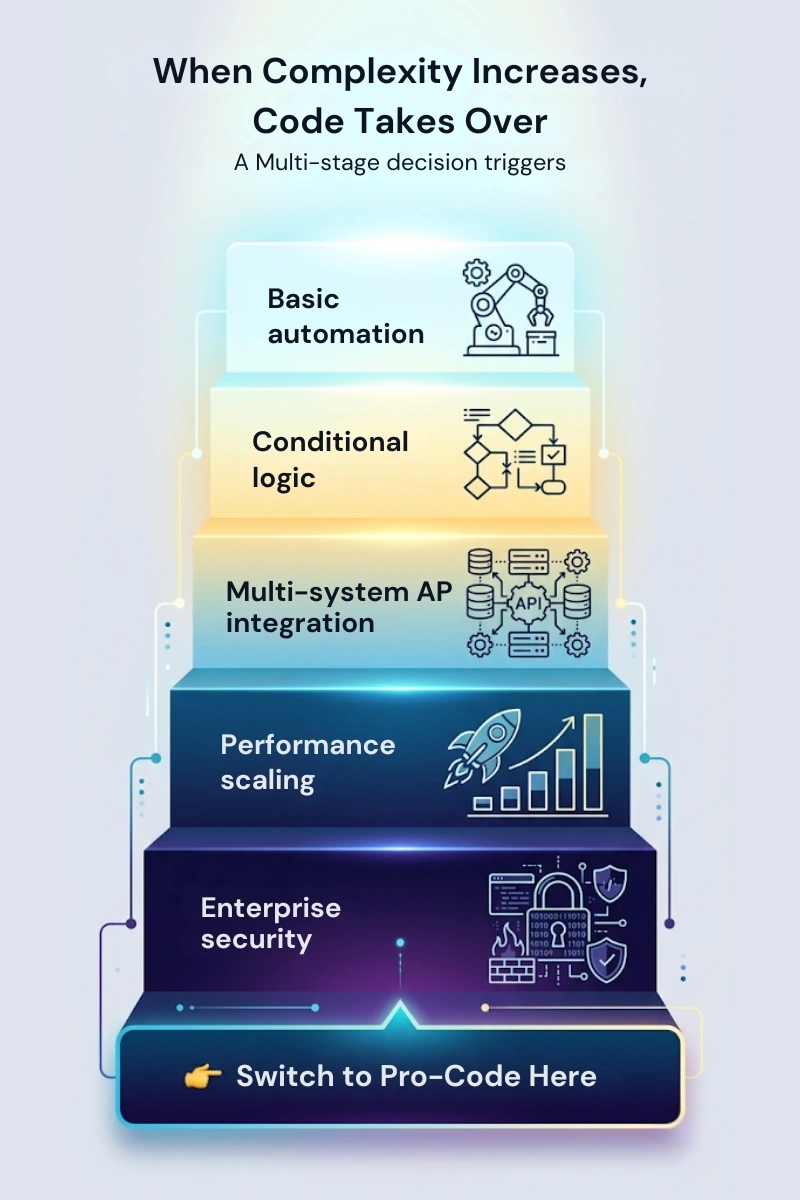
Where Low-Code Starts to Break
Low-code is powerful, but it has limits.
You will start noticing friction when:
Logic Becomes Complex
Multiple decision layers, nested conditions, or dynamic workflows become difficult to manage visually.
Integrations Go Beyond Standard
Custom APIs or legacy systems rarely fit into prebuilt connectors.
Performance Becomes Critical
At scale, inefficient configurations can slow down execution.
Security Gets Advanced
Fine-grained control over access, data handling, or compliance often requires code-level precision.
At this stage, continuing with only low-code creates long-term inefficiencies.
What is Pro-Code in AgentForce
Pro-code introduces full development control into your agent architecture.
It allows developers to extend AgentForce using structured programming and engineering practices.
Key Pro-Code Capabilities
- Apex-based custom logic
- External API integrations
- Agent scripting via CLI tools
- Version control and CI/CD pipelines
This is where your agent evolves from functional to enterprise-ready.
Where Pro-Code Becomes Essential
Pro-code is not about preference. It’s about necessity.
Complex Business Logic
When workflows involve multi-layered calculations, dynamic conditions, or decision engines.
Deep System Integrations
Connecting with external platforms, legacy systems, or custom data services.
Performance Optimization
Handling high-volume requests with efficiency and stability.
Governance and Compliance
Ensuring:
- Secure data handling
- Audit-ready processes
- Controlled deployments
Low-Code vs Pro-Code: A Practical Comparison
| Use Case | Low-Code | Pro-Code |
| Prototyping | Yes | No |
| Business-led workflows | Yes | No |
| Standard CRM automation | Yes | No |
| Complex decision logic | Limited | Yes |
| Custom API integrations | Limited | Yes |
| High-performance systems | Limited | Yes |
| Enterprise compliance | Partial | Strong |
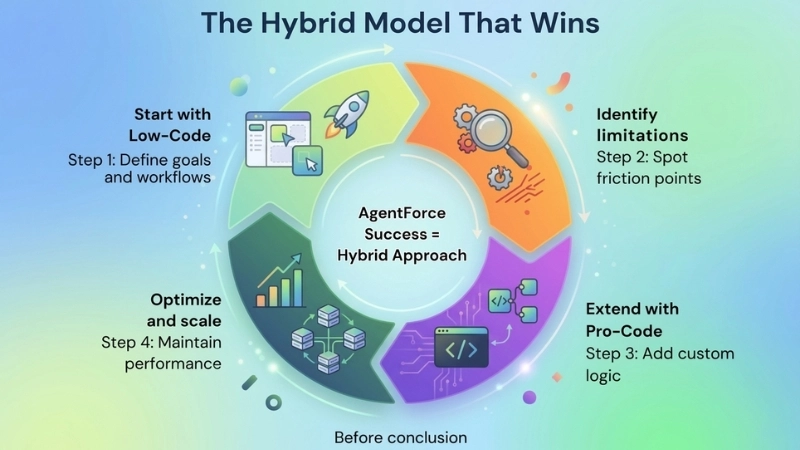
The Hybrid Approach That Actually Works
The most successful AgentForce implementations do not choose one approach.
They combine both.
Step 1: Start with Low-Code
- Define agent goals
- Build workflows
- Validate outcomes
Step 2: Identify Limitations
- Where logic becomes messy
- Where integrations fail
- Where performance drops
Step 3: Extend with Pro-Code
- Build custom Apex actions
- Integrate external systems
- Optimize execution
Step 4: Maintain Alignment
Use structured processes like:
- Salesforce DX
- Version control systems
- Deployment pipelines
Common Mistakes to Avoid
Over-Relying on Low-Code
Trying to force complex logic into visual tools leads to fragile systems.
Over-Engineering Too Early
Jumping into pro-code before validating the use case slows down innovation.
Ignoring Collaboration
Separating admins and developers creates disconnects in agent behavior.
Final Thoughts
Low-code gives you speed. Pro-code gives you control.
But real success in Salesforce Agentforce comes from knowing how to use both at the right time.
Start simple.
Scale intelligently
Build with intent.
Because the best AI agents are not the ones built fastest or the ones built with the most code.
They are the ones built the right way, at the right time.